It sounds like an object. Something applied. Something chosen from a book and placed on the body, the way a picture is hung on a wall.
But the color is not hanging there.
It entered through a wound.
A needle broke the surface again and again, carrying pigment into the living layers beneath it. There was blood. Heat. Swelling. Then the tightening of a scab.
The body did what it has always done.
It healed.
The wound disappeared.
The color did not.
What do you call it after it heals?
When the bleeding ended?
When the scab fell away?
When new skin formed over it?
Or eleven years later, when I could no longer remember my arms without color?
There are figures beneath my skin whose faces dissolve into color.
I no longer know how to answer for them.
Not because there isn’t a story.
Because there isn’t only one.
Memory does not preserve a face forever. It keeps stranger things: the angle of someone’s shoulders, the distance between two people, the feeling that someone once stood close enough to change your life.
Then, one day, it reaches the face and spills.
Color remembers what detail cannot.
These images may outlive my face.
Perhaps that is why the people beneath my skin have no faces either. They exist the way memory exists: recognizable, but never entirely recoverable.
Perhaps the word has always bothered me because it continues to name the wound long after the wound has disappeared.
I stepped away from my friends and pressed the phone closer to my ear.
New Orleans continued around me.
Music through an open doorway. Rain shining on the street. Someone laughing nearby.
I asked him to repeat himself.
I still could not hear him.
Later, a message arrived.
Something close to:
I can’t do this with you anymore.
I have forgotten every word he said.
I remember every word I wrote.
I had always been the one who left.
I knew when the air had changed. I knew when affection had begun to turn into something else. I knew how to reach the door before anyone could close it behind me.
But I had known him for decades.
He belonged to the long history of my life, and I had mistaken history for proof.
There had already been reasons to leave.
I knew them.
Still, I stayed.
That was the part I could not forgive.
Not that he ended it.
That I had remained long enough for him to.
That night, I went to Chuck’s Bar.
I sat outside.
By then, the screen had begun to divide itself in two. I remember closing one eye, trying to make the words stay where I put them.
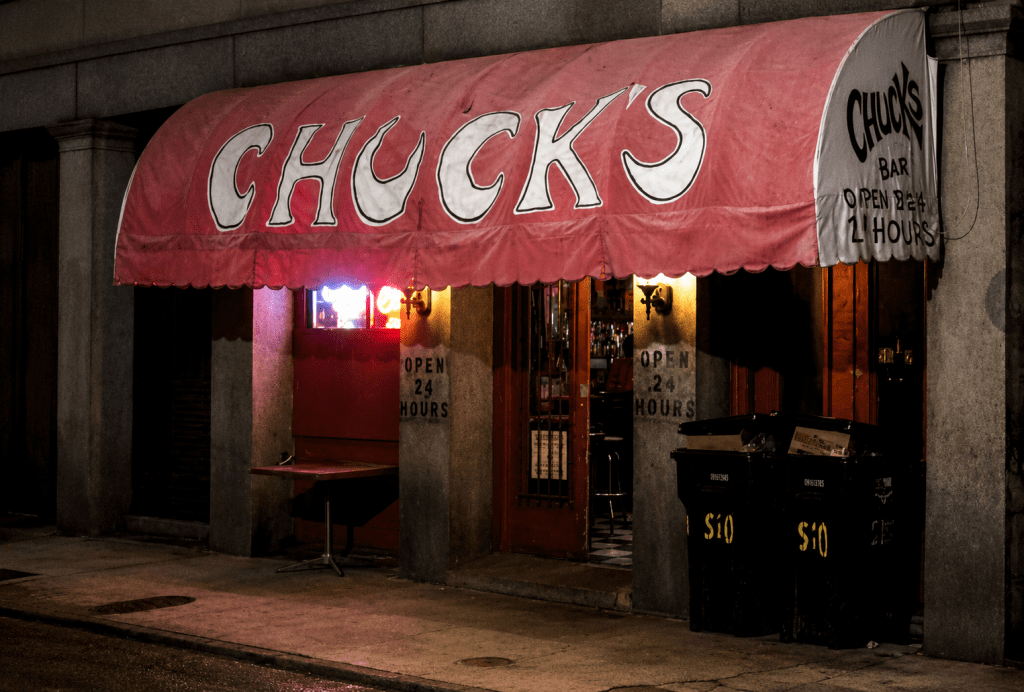
Chuck’s Bar
I long to be something stronger
than a woman
who once loved you.
September 6, 2015
Four lines.
Nothing about New Orleans. Nothing about the call. Nothing about the message.
Only the wish to become someone else.
For years, I believed the poem was about him.
It was written against the woman who had stayed.
I thought she had failed me. I wanted to become stronger than she was because I did not yet know how to forgive her.
Years passed.
He asked me to forgive him.
I did.
Today, we are friends.
I still see him tenderly.
That would have been impossible to the woman sitting outside Chuck’s Bar, closing one eye against the doubled screen.
She hated him.
God, she hated him.
But time returned him to his proper size.
When I read those four lines now, I no longer hear a woman asking to become stronger.
My mother says I cannot speak like a normal person. She says every conversation with me turns into a metaphor with no parking.
“Talk to me like a human being,” she says. “I don’t need a poem. I asked you a question.”
And I laugh, because she is right.
Then I tell her, “Well, I’m not human. So why would I speak to you like one?”
This, of course, does not help.
She looks at me like I have personally insulted common sense.
“Enough.”
“Speak normally.”
But somewhere along the way, my thoughts stopped walking in straight lines. They started taking the scenic route, turning left where everyone else would have simply answered.
And please understand—
this is incredibly amusing to me.
Because my mother is not a woman without language. No. My mother has language. She can say one sentence and make it sound like a door being thrown open during a storm.
So when she tells me not to speak in poetry, do you understand how funny that is?
This woman, who can slice the air with one sentence, wants me to hand her plain bread.
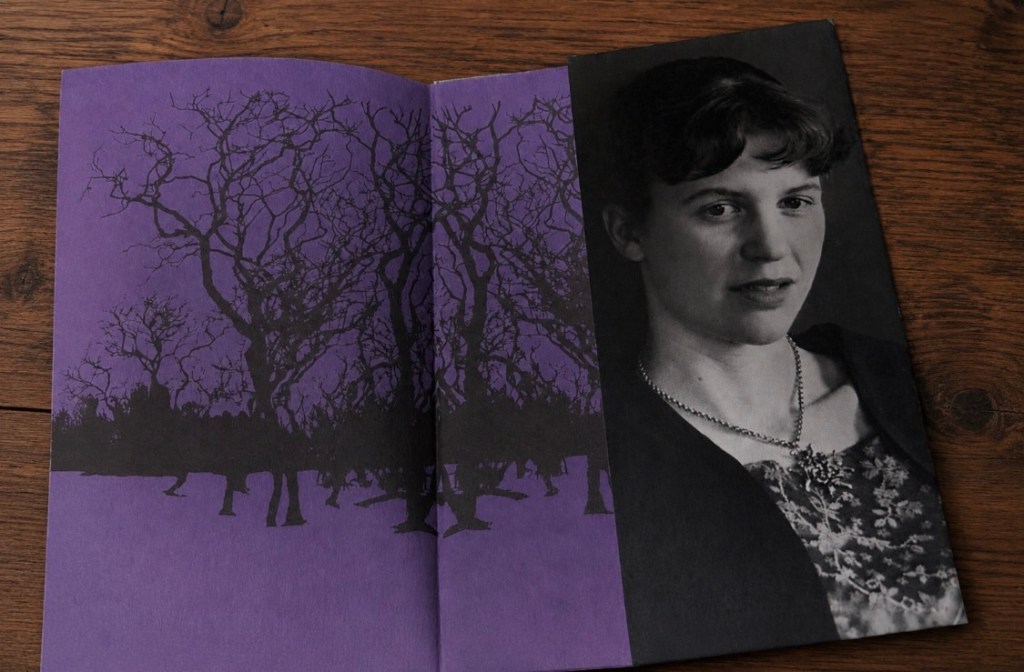
I own the entire collection of Sylvia Plath.
Every book.
Every page.
Every bruise.
I have not opened a single one in over a decade. Not because I stopped admiring her. I didn’t.
It is just that somewhere along the way, those books became less about Sylvia Plath and more about my mother.
Once, while we were rearranging books, I left my Sylvia Plath collection on the coffee table. My mother and I both own a ridiculous number of books, but I do not write in mine. I do not underline. I leave the pages alone.
So when I came back and saw ink on Sylvia Plath, I almost left my body.
My mother had underlined things.
Not gently.
Not in pencil.
Ink.
On the page.
In my book.
As if Sylvia Plath had not already suffered enough.
Then she looked at me and asked, “Does this make any sense to you?”
And I said, “Well, you have to look at her from where she was standing.”
My mother shook her head.
“This is the most heartbreaking thing. There is no joy in these books.”
And I was upset.
Obviously.
Because again,
actual ink.
But I also laughed, because somehow my mother had managed to vandalize Sylvia Plath and prove my entire point at the same time.
Ever since that day, I have quoted Sylvia Plath to my mother every chance I get. Not because I’m feeling particularly Plath-like. Not always.
Sometimes I do it simply because she underlined my books.
This is what you get.
You touch my Sylvia Plath, and now you have to live with Sylvia Plath.
Forever.
Every now and then, she’ll ask, “What are you doing today? What plans do you have?”
And instead of saying work, errands, laundry, coffee, like a normal daughter, I’ll answer,
“I desire the things which will destroy me in the end”
She closes her eyes.
And I smile, because she knows.
This has nothing to do with today.
This is an old debt.
The punishment for underlining my books.
And I have every intention of collecting it for the rest of her life.
My mother has no patience for Sylvia Plath.
To me, she is a poet.
To my mother, she is a weather warning. A pressure drop. A room losing air. An anxiety rash waiting to happen.
The kind of poet who makes my mother’s soul reach for antihistamines.
Too much ache.
Too much bell jar.
Too much woman
making pain answer back.
So when my mother tells me not to speak in metaphors, I try.
I really do.
But I don’t know where normal ends and language begins.
You must be logged in to post a comment.