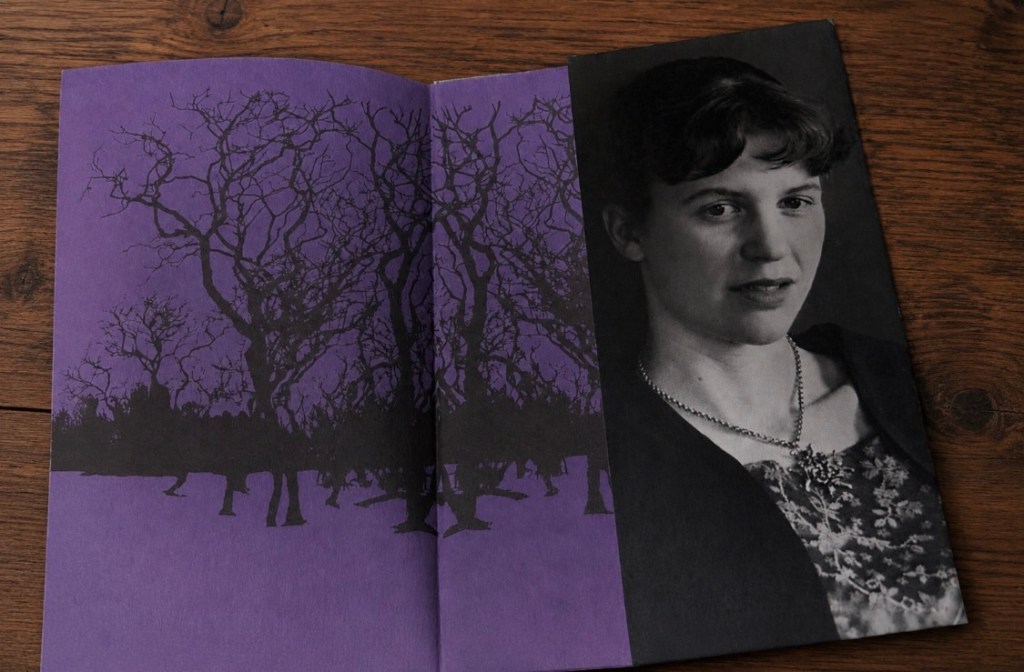
I didn’t discover her all at once. I found her in pieces, in used bookstores on the East Coast when I was in my twenties and still believed a book could explain me back to myself.
The poems. The novel. The journals. The letters.
I have lived with Sylvia Plath on my shelves for decades.
What fascinates me now is that I have never read the same Sylvia Plath twice.
The woman who first opened those books in her twenties is gone. So is the woman who returned to them in her thirties, and again in her forties.
The books never moved.
I did.
That is the strange thing about certain writers. They stay exactly where you left them, waiting for you to become another woman.
People often assume I loved Plath because of the darkness.
I didn’t.
I loved her because she refused to pretend the darkness wasn’t there.
There is a difference.
Here was a woman who seemed to do everything right.
She married. She had children. She wrote. She built the life women were expected to want.
And still.
There was an inner life that refused to be resolved.
That was the part I never got over.
The way a woman can do all the right things and still remain suspended within herself.
Maybe that is why I understood her before I knew how to explain myself.
I have not opened one of her books in years.
Not because I stopped loving her.
Because I survived many things with Sylvia Plath.
And surviving is not the same as staying.
I think that is what literature does if you live long enough.
It does not change.
You do.
And every time you return to it, it hands you a different version of yourself.
The greatest gift Sylvia Plath gave me was never only her words.
It was knowing someone had reached those dark, suspended places before me and left language there.
So when I arrived, I did not feel entirely alone.
Thirty years later, her books are still on my shelf.
My mother says I cannot speak like a normal person. She says every conversation with me turns into a metaphor with no parking.
“Talk to me like a human being,” she says. “I don’t need a poem. I asked you a question.”
And I laugh, because she is right.
Then I tell her, “Well, I’m not human. So why would I speak to you like one?”
This, of course, does not help.
She looks at me like I have personally insulted common sense.
“Enough.”
“Speak normally.”
But somewhere along the way, my thoughts stopped walking in straight lines. They started taking the scenic route, turning left where everyone else would have simply answered.
And please understand—
this is incredibly amusing to me.
Because my mother is not a woman without language. No. My mother has language. She can say one sentence and make it sound like a door being thrown open during a storm.
So when she tells me not to speak in poetry, do you understand how funny that is?
This woman, who can slice the air with one sentence, wants me to hand her plain bread.
I own the entire collection of Sylvia Plath.
Every book.
Every page.
Every bruise.
I have not opened a single one in over a decade. Not because I stopped admiring her. I didn’t.
It is just that somewhere along the way, those books became less about Sylvia Plath and more about my mother.
Once, while we were rearranging books, I left my Sylvia Plath collection on the coffee table. My mother and I both own a ridiculous number of books, but I do not write in mine. I do not underline. I leave the pages alone.
So when I came back and saw ink on Sylvia Plath, I almost left my body.
My mother had underlined things.
Not gently.
Not in pencil.
Ink.
On the page.
In my book.
As if Sylvia Plath had not already suffered enough.
Then she looked at me and asked, “Does this make any sense to you?”
And I said, “Well, you have to look at her from where she was standing.”
My mother shook her head.
“This is the most heartbreaking thing. There is no joy in these books.”
And I was upset.
Obviously.
Because again,
actual ink.
But I also laughed, because somehow my mother had managed to vandalize Sylvia Plath and prove my entire point at the same time.
Ever since that day, I have quoted Sylvia Plath to my mother every chance I get. Not because I’m feeling particularly Plath-like. Not always.
Sometimes I do it simply because she underlined my books.
This is what you get.
You touch my Sylvia Plath, and now you have to live with Sylvia Plath.
Forever.
Every now and then, she’ll ask, “What are you doing today? What plans do you have?”
And instead of saying work, errands, laundry, coffee, like a normal daughter, I’ll answer,
“I desire the things which will destroy me in the end”
She closes her eyes.
And I smile, because she knows.
This has nothing to do with today.
This is an old debt.
The punishment for underlining my books.
And I have every intention of collecting it for the rest of her life.
My mother has no patience for Sylvia Plath.
To me, she is a poet.
To my mother, she is a weather warning. A pressure drop. A room losing air. An anxiety rash waiting to happen.
The kind of poet who makes my mother’s soul reach for antihistamines.
Too much ache.
Too much bell jar.
Too much woman
making pain answer back.
So when my mother tells me not to speak in metaphors, I try.
I really do.
But I don’t know where normal ends and language begins.


 Mari Sánchez Cayuso
You must be logged in to post a comment.