I have spent so much time
trying to become
someone
who didn’t love you.
Nothing changed.
Except
the person
trying.
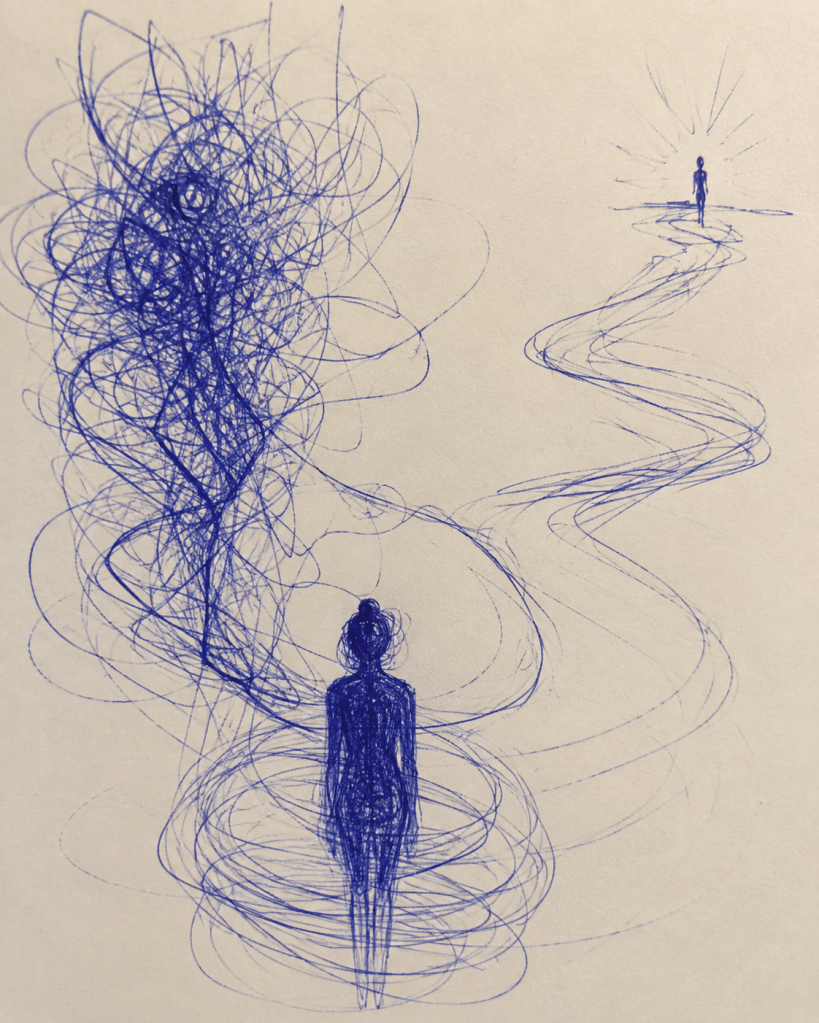
I have spent so much time
trying to become
someone
who didn’t love you.
Nothing changed.
Except
the person
trying.
I have journals everywhere.
Some are stacked on shelves.
Some are hidden inside drawers.
Some I have carried with me for years
without opening.
Every once in a while
I pull one out
and read a few pages.
Sometimes I recognize the handwriting
before I recognize the person.
I know I wrote it.
I know where I was living.
I know what was happening.
I know the names.
But I read the words
and wonder
What mental state was I in to write this?
The thoughts contradict each other.
One sentence believes something.
The next one destroys it.
Nothing stays true
for very long.
The language is abstract
conflicting
irrational
as though the words
were dropped from the sky
and I spent entire pages
trying to arrange them
into a life.
Sometimes, honestly
it makes no sense at all.
I used to think
that kind of writing
was profound.
Maybe some of it was.
But some of it
was simply confusion
given a pen.
And sometimes
I feel sorry for her.
I look at the handwriting
the words pressed too deeply
into the paper
the sentences running
into one another
and I almost want
to reach through the years
and hug myself.
It is surreal
to feel tenderness
for someone
who is still you
but no longer exists.
Back then
I never imagined
I would see myself differently.
I thought the way I felt
was permanent.
I thought every thought
was the truth.
I could not imagine
that one day
I would open those journals
and read them
from the other side.
That was a different stage
of my life.
I understand that now.
Every stage asks us
to become someone
we cannot yet recognize.
And maybe the purpose
is not to erase
who we were
but to look back
recognize her
forgive her
and keep moving.
Sometimes I want to tell her
that she will not always
feel this way.
That one day
she will read these pages
without falling back into them.
That healing will happen
so quietly
she may not notice it
until years later
when she opens an old notebook
and realizes
she is reading the words
of someone she once was
someone she still loves
but no longer has to be.
She would not believe me.
Back then
I could not see beyond
the next sentence.
I kept writing
because I thought
the words might save me.
But the more I wrote
the further I disappeared.
I was not writing
my way out.
I was drowning in ink.
For as long as I can remember, my dreams have had architecture.
Not mountains. Not oceans.
Hallways.
Hospital corridors. Hotels. Schools I have never attended. Houses that belong to no one I know. Fluorescent lights. Closed doors. Numbers I cannot quite read.
There is always another room. I am always trying to find it.
Sometimes I know what is behind the door. Most of the time, I do not.
Lately, I have begun to wonder whether I have spent my entire life this way—not in rooms, but between them.
A hallway is not meant to be lived in. It exists only because there is somewhere else to go. No one chooses one as a destination. No one says, this is where I will stay.
And yet, so much of my life has happened there: in waiting, in becoming, in the long, unfinished passage between one version of myself and the next.
A few months after my father died of lung cancer in 2014, I had a dream.
I was inside a hospital. People were moving quickly through the corridors, rushing in and out of rooms, carrying papers, calling to one another. There were doors everywhere.
Someone stopped me and said they had pulled my father out for me. He was in a room down the hall.
Room 214, maybe.
A woman in scrubs caught my arm before I reached it.
They had found a cure, she told me.
Not for every cancer.
For his.
They had brought him back.
Even in the dream, I knew this was impossible. My father had been cremated. I remember thinking it clearly.
He was cremated.
But I followed her anyway.
Hope has never required evidence.
He was lying in a hospital bed, thin and fragile, the oxygen cannula still beneath his nose. He looked exactly as I remembered him near the end.
But he was breathing.
That was all I could see.
He was breathing.
I went to him as if I had been handed a miracle and was afraid it might be taken back if I asked too many questions.
I told him they had found a medicine. I told him it was saving people. I told him he did not have to die anymore.
He looked at me.
Then he reached for my hand.
He had very little strength, but his fingers closed around my wrist with surprising force.
“Let me rest,” he said.
Then he turned onto his side.
Underneath him were the ashes.
All of them.
Ashes beneath the body that was still breathing.
I woke terrified.
For years, I remembered the dream as a message about death. Now I am not sure it was.
Maybe the hallway had been there all along.
There have been many of them since: the corridor outside my father’s room, the hallway outside my sons’ bedrooms when they were still young enough to need me, the airport passage where one of them walked away in uniform and did not look like a child anymore, the narrow stretch of my own house after everyone has gone home, a restaurant after closing—chairs turned over, lights lowered, the day emptied out of it.
Even now, I am often standing somewhere between what was and what comes next.
Not grieving as I once did.
Not free of it either.
Not the woman I was.
Not yet the woman I am becoming.
A hallway.
The cruel thing about hallways is that you can still see the door behind you. Sometimes you can still hear voices through it.
But you cannot live there anymore.
I have spent years trying to return to rooms that no longer exist: the room where my father was alive, the room where my sons were children, the room where I believed love, if it was deep enough, would eventually become honest, the room where I knew who I was.
But memory is not a key.
It opens nothing.
It only lets you stand close enough to remember the shape of the handle.
Maybe that is why my dreams keep building hallways.
Rooms suggest arrival. They suggest certainty. They suggest that something has finally been decided.
Hallways do not lie that way.
They admit that we are between things. They admit that the person who enters is not always the person who comes out. They admit that sometimes there is no revelation on the other side.
Sometimes there is only another corridor.
Another number.
Another door.
I used to think transition meant I was lost. Now I think it may be the most honest place a person can stand—not where she was, not where she is going, but in the long passage between them.
And perhaps that is why my dreams never give me a destination.
I have spent so much of my life becoming someone else that my subconscious no longer bothers building rooms.
It builds another hallway.


You must be logged in to post a comment.