Tag: creative writing

  • The Synchronicities of Panic

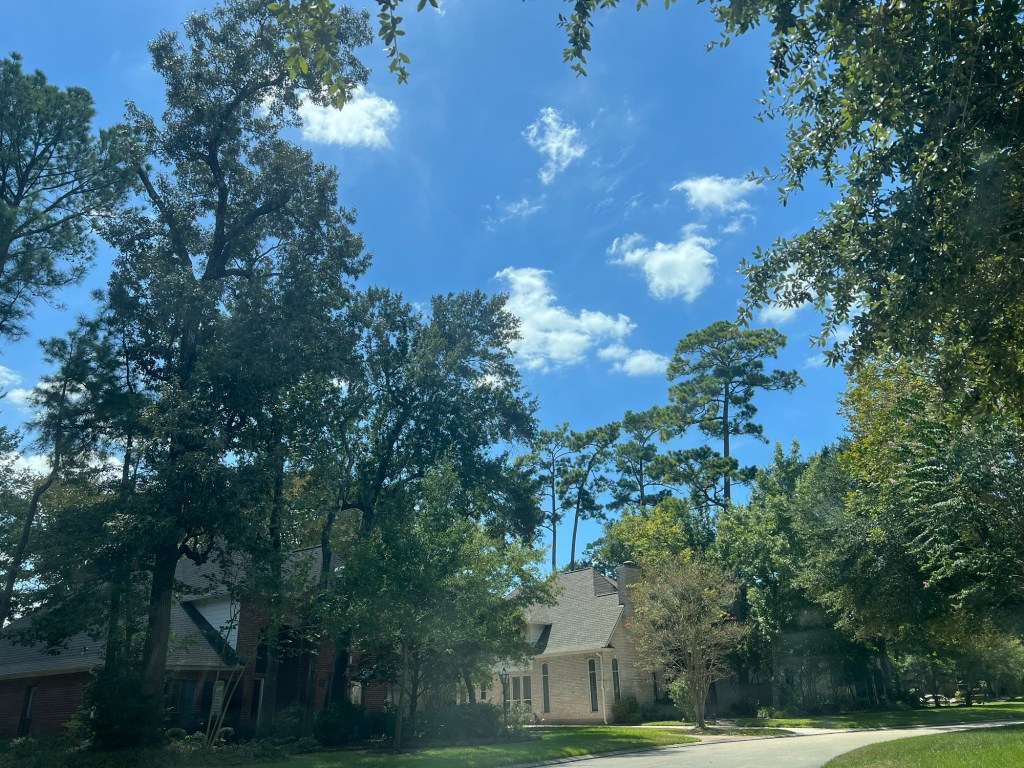
    Bricks. Roof. Trees. Sky.
    Beige. Green. Blue. White.

    Four tangible things.

    I was taught this fifteen years ago, and somehow I have carried it everywhere since. When panic comes, look outward. Name what is real. Give the mind something it cannot argue with.

    A roof is a roof. A tree is a tree. The sky is blue.

    Start there.

    Inhale slowly. Exhale longer.

    Again.

    Panic is strange because even when you know exactly what it is, your body does not care.

    My mind says, I know this feeling.

    My body takes longer to trust me.

    So I pull over.

    I park beneath a tree, lean the seat back, and wait. Because that is what you do. You wait for your body to catch up with what your mind already knows.

    You are okay.
    You are okay.
    You are okay.

    And then panic does this other strange thing to me.

    It takes me backward. Not to one particular day, but to that old maternal terror of loving something I cannot control.

    That fear.

    The one that says, fix it, fix it, fix it, even when there is nothing you can fix in that exact second.

    It makes me younger somehow.

    Not in years.
    In fear.

    So I do not follow it there.

    Bricks. Roof. Trees. Sky.

    Come back.

    There is a bird in the tree above me. I watch it flap its wings, chirp, move from one branch to another. Its entire purpose, for that moment, is exactly that.

    And I envy it.

    Not because it is free.

    Because it is only where it is.

    No yesterday. No next thing. No inventory of everything that could go wrong.

    Just branch.
    Wing.
    Sound.
    Gone.

    Birds are fleeting that way.

    Maybe that is why I notice them when I am afraid. They arrive without explanation and leave before I can ask anything of them.

    And for a second, I follow that instead.

    My breathing gets better. I can feel myself coming back into my body.

    And then I cry.

    Not because I am more afraid.

    Because I am not.

    Because sometimes after all that fear, there is nowhere for it to go except out.

    So I let it.

    I write this down quickly because later I know what I will do. I will be fine. I will get up. I will drive. I will go do whatever comes next.

    And I will say, I had a panic attack, as though those four words could possibly explain what it felt like while I was inside it.

    So I write it now.

    Before I make it smaller.
    Before I forget the fear.
    Before I forget the relief.

    The tree.
    The breath.
    The bird.

    Bricks. Roof. Trees. Sky.

    Come back.

    The bird lifts from the branch.

    And I do too.

  • Inalterable

    I have spent so much time
    trying to become
    someone
    who didn’t love you.

    Nothing changed.

    Except
    the person
    trying.

  • Living Tissue

    Literature, to me,
    is a living organism.

    Its pages are tissue.
    Its margins, skin.

    Every sentence
    makes an opening.

    This page has a pulse.

    It beats
    beneath your eyes.

    But it is also my house—

    the body
    my mind returns to
    when it has nowhere else
    to go.

    This is where it stops,
    where it rests,
    where it lays down
    what it has carried
    too long.

    A thought enters
    and removes its coat.

    A memory sits
    at the edge of the bed.

    What I cannot say aloud
    finds a room here.

    That is how we meet—

    through the fibers
    of the web,

    your eyes moving
    through the place
    where I have left
    pieces of myself.

    Mycelium

    Some readers arrive
    like stitches.

    Some arrive
    with clean hands
    and know instinctively
    where not to touch.

    Others come
    with no intention
    of being gentle,

    turning the wound
    toward the light
    to see
    what refuses
    to close.

    A page remembers
    every person
    who has handled it.

    It changes temperature.
    It alters its breathing.

    Sometimes
    it begins bleeding
    before the reader
    has reached the end.

    Coagulation
    is inconsistent.

    It depends
    on who found the wound—

    on whether they came
    to close it,
    to study it,
    or simply
    to watch it bleed.

    Perhaps you came
    only to read.

    Perhaps you did not know
    that reading
    is a form of touch.

    But now you are here,

    inside the house
    my mind built
    to survive itself.

    And for as long
    as you remain,

    the walls keep breathing.
    The page keeps beating.

    Somewhere between
    your eyes
    and my words,

    the distance
    becomes tissue.

  • Notes

    I want to kiss you

    because silence
    has become too crowded
    inside me.

    Maybe

    if I reached
    your mouth

    I could finally learn

    the grammar

    of everything

    you refuse
    to say.

  • Point of Entry

    People ask me about technique.

    I disappoint them.

    I have never sat down
    to write a poem
    thinking about meter
    or form
    or whether the line
    should break here
    instead of there.

    That does not mean
    those things do not matter.

    It means they were never
    my point of entry.

    I don’t write
    because I understand
    what I’m feeling.

    I write
    because I don’t.

    I don’t know where a poem begins.

    I only know
    that sometimes
    I write a sentence
    and spend years
    becoming the person
    who can understand it.

    Maybe that is where the poem begins.

    Not in clarity.

    In the private disorder
    language has not yet learned
    how to hold.

    The poem arrives before the explanation.

    Before the lesson.

    Before the clean version
    people prefer
    after pain has been made useful.

    I do not trust that version.

    I trust the fragment.

    The unfinished sentence.

    The line that breaks
    because something in me
    cannot continue
    without silence.

    That is technique too.

    Not the kind I studied.

    The kind the body invents
    when the mind
    has no argument left.

    The poem knows before I do.

    It knows where I am hiding.

    It knows what I am circling.

    It knows the truth
    before I can survive
    saying it plainly.

    That is why I write this way.

    Not to confess.

    Confession suggests
    I have arrived somewhere
    with evidence in my hands.

    Most of the time
    I have not arrived.

    Most of the time
    I am still standing
    inside the question.

    And the poem—
    if it is honest—
    does not answer it.

    It simply stays there
    with me

    long enough
    for something true
    to recognize itself.

  • Nothing to Say

    I have nothing to say.

    Which is strange,
    because my mind
    rarely gives me silence.

    I’ve been away.

    I’ve been thinking.

    And whatever happened to me
    is still happening.

    Maybe that’s why
    I keep reaching
    for words
    that aren’t ready
    to belong to me yet.